We like to stay up to date with the latest developments that arise in our sector, and of course, tell you about them on our blog. Therefore, today we talk to you about a current topic: autonomous driving in the transport of goods.
The Technology advances with giant steps; in it transportation sector We see how we increasingly have new advantages that benefit companies and users. Currently there are smarter vehicles and innovative machinery which allows transporters to work with more quality and efficiency.
All these innovations make day-to-day transportation of goods easier. But there is no doubt that, for the technological innovations can truly be advantageous for everyone, they must be integrated safely and little by little.
Autonomous Driving, a challenge?
All this makes us ask ourselves a question in reference to the Autonomous driving, is it a challenge for freight transport companies? Without a doubt, to answer it, several factors must be taken into account.
In the case of our country, the freight transport sector is made up of more than 30,000 companies; of which more than 95% are dedicated to road transport. This means that autonomous driving, in the future, could weaken a large number of transporters. Especially because they don't make a high profit margin; aspect that is related to that Of this high percentage of road transport companies, the majority are microenterprises.
Continuing with the percentages, approximately a quarter of the total freight transport companies in Spain are made up of small companiesThen 4% are medium-sized companies, and only 1% are large transport companies.
Can autonomous vehicles replace the driver-driven goods transport service?
At this point, we ask ourselves Can autonomous vehicles replace the driver-driven goods transport service?
It is possible that, probably within many years, drivers of goods transport vehicles will give way to autonomous driving. Although maximum reliability security systems will be needed to be able to trust driverless vehicles.
Currently, it is not feasible to use autonomous vehicles to deliver merchandise; No matter how much technology has advanced, still nothing can replace a carrier for the transport of goods by road.
Furthermore, autonomous driving requires that current infrastructures also be renewed, which entails a large investment and detailed study of new systems that offer quality and safe solutions.
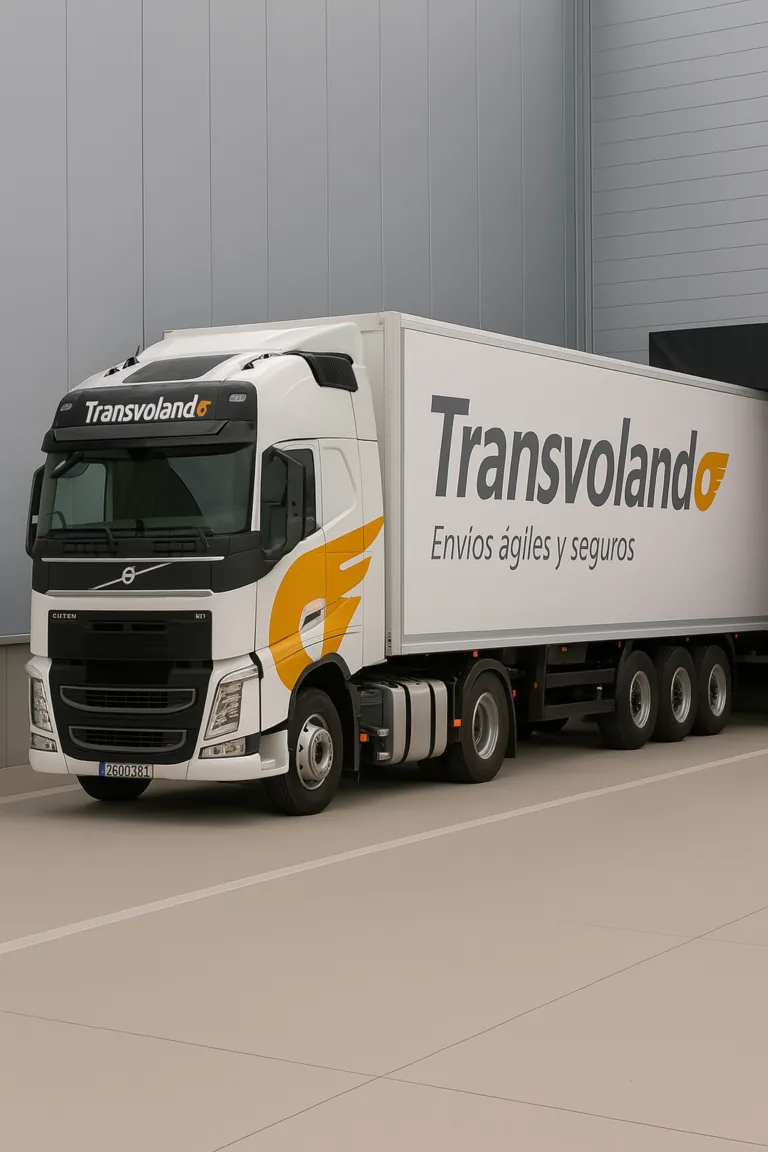
En TransvolandoFor the moment, we continue to update and improve to offer the best Service in a road freight transport.
Contact: +34 674 346 912 info@transvolando.comAddress: C/ Empleo, 28 Nave 10 28906 – Getafe (Madrid, España) How to get there?Do you need anything else…?
Many times we need the support of something more than a word.
If we can help or accompany you in this process of choosing our services, contact us and we will respond as soon as we put the brakes on!
budget
If you are here it is because you need a freight transportation service and we are sure that we can provide it! Request a free quote en menos de 3 minutos a tan solo un click.Frequently Asked Questions about Autonomous Driving in Transport
When will autonomous driving be a reality in road freight transport?
EU roadmap updated 2025: 1) 2025-2027: Level 4 on controlled motorways (specific EU corridors). 2) 2027-2030: Level 4 on general motorways with remote human backup. 3) 2030-2035: Level 5 (fully autonomous) in commercial trials. 4) 2035+: Mass adoption. For B2B: 2026-2030 fleet investment plans must consider autonomy-ready. Operators investing early (2026-2028): cost -15-25% vs late adopters.
What advantages and disadvantages does autonomous driving have for my loader business?
B2B advantages: 1) Transport cost reduction 25-40% (no driver 24/7). 2) Accident reduction 80-90% (IIHS statistics). 3) Fuel efficiency +15% (optimal driving). 4) Total traceability (sensors). 5) 24/7 availability without rest. Disadvantages: 1) Initial vehicle investment +30-50%. 2) Route limitations (only approved). 3) Contract changes (new regulation). 4) Resistance from current drivers (union). 5) Cybersecurity risk. B2B net balance: positive from year 3-5.
What type of cargo will be the first transported with autonomous vehicles?
Sector prediction: 1) Homogeneous commodity cargo (bulk, containers) — 2027. 2) FTL on EU motorway corridors (Madrid-Valencia, Barcelona-Paris, Madrid-Lisbon) — 2028-2030. 3) E-commerce cargo in hubs (Autonomous Last Mile) — 2025-2027. 4) Refrigerated and pharma with sensor tracking — 2030+. 5) Hazardous cargo (ADR) — last in transition (2035+). For B2B with commodity on EU corridors: early adoption opportunity.
How do I position my business to capture autonomous driving?
Five strategic actions 2026-2030: 1) Current fleet audit (what is autonomy-ready). 2) Level 4-ready vehicle investment plan (2026-2028). 3) Team training (AI engineer, advanced maintenance technician). 4) Technology alliances (Volvo, Daimler, Tesla Truck). 5) Cybersecurity certification (ISO 27001). Total investment: €200-500K. ROI: 36-60 months if plan well-executed. Businesses that wait: lose market share 15-25% in 5 years.
What European regulation is in progress on autonomous driving for transport?
Three critical regulations 2025-2030: 1) EU Regulation 2019/2144 — updated 2025 with mandatory assistance systems (LKA, AEB, ACC). 2) UNECE Regulation for Level 4 vehicles — common European homologation 2026. 3) EU Civil Liability Directive — manufacturer assumes Level 4-5 accident liability. Operating businesses: 1) UNECE-homologated vehicles. 2) Defined operator liability. 3) Traceable trip + vehicle state data. Day-one compliance: competitive advantage.
Need part-load / groupage?
Your pallets ride with other consignments. Save the full-lorry cost without missing your delivery date.