Abnormal-load transport between the UK and Spain, planned and permitted end-to-end. When your cargo is over 2.55 m wide, 4 m tall or 44 tonnes, it falls outside standard road freight rules — in either country. Every country has its own permit system, escort rules and route-survey requirements, and getting it wrong costs days and money. This guide explains how the UK–Spain lane works for abnormal loads, what the Spanish permits actually cover, and what UK shippers can do to keep the move on track.
What counts as an abnormal load?
An abnormal load is any cargo that exceeds the maximum weights or dimensions set out in the road vehicle regulations of the country it’s moving through. The specific thresholds differ between the UK and Spain:
| Dimension | UK standard max | Spain standard max |
|---|---|---|
| Length (articulated) | 16.5 m | 16.5 m |
| Width | 2.55 m (2.6 m for some box types) | 2.55 m |
| Height | No absolute limit (4.95 m practical) | 4 m |
| Gross weight | 44 t (up to 54 t with STGO) | 40 t (44 t for intermodal) |
Exceed any of these and you’re into abnormal-load territory. That triggers permit requirements, route survey, possibly escort vehicles and tighter time windows.
Spanish permit system explained
Spain’s Directorate-General for Traffic (DGT) issues two tiers of authorisation for abnormal loads:
Generic authorisation
Covers vehicles with a maximum 20.55 m length × 3 m width × 4.5 m height and total combined mass up to 45 t. Generally limited to 40 km/h and with time-window restrictions that vary by region. No individual route approval required, but operators must be registered and the load must fit within these dimensions.
Specific ACC authorisation (Autorización Complementaria de Circulación)
Covers vehicles up to 40 m length × 5 m width × 4.7 m height, provided the total mass stays under 110 t. The approved speed is up to 70 km/h (though lower ITV card limits always prevail). These vehicles can travel both day and night subject to the specific itinerary.
ACC is issued after the specific route is surveyed and approved — it’s a paper/electronic permit tied to a particular origin, destination and itinerary, not a general licence. Permit lead time is typically 2–5 working days from submission.
Escort vehicles: when they’re required
Escort (pilot) vehicles are required by the ACC permit based on a matrix of dimensions:
- One pilot vehicle: when width exceeds 3 m or length exceeds 25 m
- Two pilot vehicles: when width exceeds 3.5 m, length exceeds 30 m, or height exceeds 4.5 m
- Police escort (Guardia Civil Tráfico): for the largest loads, night moves on main corridors, or load-specific risks (typically ordered alongside the permit)
Escort vehicles need to be properly equipped (rotating beacons, signage, radio comms with the tractor) and the driver trained for escort duty. In Catalonia, the SCT adds its own requirements; in the Basque Country, the regional traffic authority does the same on top of the DGT permit.
Catalan and Basque specifics
Two regional authorities that catch UK shippers off guard:
- Catalonia — SCT (Servei Català de Trànsit): any abnormal-load movement in Catalonia requires at least 24-hour prior notification to the Mossos d’Esquadra, and up to 72h when escort is involved. Certain corridors have time restrictions even with a permit
- Basque Country — Ertzaintza: the regional police run their own permit validation on top of DGT. Lead time and restrictions similar to Catalonia
- City centres: cross-border abnormal-load moves ending in Madrid, Barcelona or Valencia often require a separate ayuntamiento permit for final-mile access with time windows (typically pre-dawn or post-midnight)
UK side: STGO and the Notification regime
On the UK end, Special Types General Order (STGO) and the Notification regime (Notification 46 or Special Order depending on the category) cover abnormal-load movements. Depending on weight and dimensions, the UK carrier needs to notify the police forces whose area is crossed, sometimes the highway authorities, and file notice in advance (typically 2–5 working days). We coordinate this with the UK haulier as part of the end-to-end service.
Channel crossing with abnormal cargo
Not every ferry or Eurotunnel shuttle accepts abnormal loads. DFDS and P&O Ferries have specific allocations; the Eurotunnel shuttle has its own dimensional limits. Booking ahead is mandatory — «walk up» doesn’t work for abnormal cargo. The crossing is usually the easiest leg once you’ve booked the right slot.
What UK shippers should do before quoting
- Confirm exact dimensions including protrusions — mirrors, hydraulic lines, anything that sticks out. Width with lashing counts
- Provide accurate weight — not a rough guess. Underweight declarations cause fines at the first weighbridge check
- Identify lashing points — where the load can be safely chained. Photos help
- Describe the load status — rolls, slides, static, self-driven; this changes the trailer choice
- Flag any urgency up front — rush permits are possible but the lead time doesn’t collapse below 48–72 hours normally
Indicative pricing
| Scenario | UK → Madrid indicative (€) |
|---|---|
| Oversized cargo (under 3 m wide, no escort) | €4.500–€5.500 |
| Abnormal load with ACC permit + one escort | €6.500–€8.500 |
| Heavy haul (60–90 t) with multi-axle modular trailer | €9.000–€14.000 |
| Very large (wind turbine blade, refinery module) | Project quote from €12.000 |
Indicative 2026 prices. Final quote depends on exact dimensions, weight, route specifics, permit and escort requirements, and seasonal availability of specialist trailers. Every abnormal-load move is quoted individually after a route survey.
Frequently asked questions
How long does an abnormal-load move take?
5–10 working days end-to-end UK → Madrid: 2–5 days for permit and route survey + 3–5 days for the actual move (depends on escort and night-running rules).
Can you do an abnormal-load move urgently?
Compressed timelines are possible (48–72 h from brief) at premium pricing and subject to permit authority windows. Not all regions can authorise same-day regardless of budget.
Do I need to be present at loading?
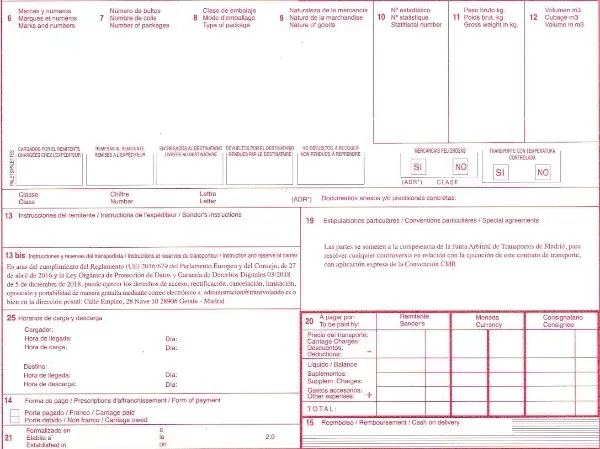
Usually yes, at least someone with authority on the consignor side — to confirm the load matches the declared spec, sign the CMR and authorise lashing decisions. At unloading, the consignee or representative signs off on condition.
What happens if the permit is delayed?
Permit authorities work on their own timelines. We track it from submission, flag risks early, and reschedule the haulier if lead time slips. Building a buffer into the project plan is the safest approach.
Can you handle the crane at both ends?
Yes — we book cranes and rigging teams at both loading and unloading where needed, coordinated with the trailer’s arrival window to avoid standstill charges.
Do you insure abnormal cargo?
Standard CMR liability (8.33 SDR/kg) applies. For high-value abnormal cargo we arrange ad valorem or all-risks insurance via our broker network — it’s usually essential given the values involved.
Ready to move abnormal cargo UK↔Spain?
Send the brief — dimensions (including protrusions), weight, origin and destination postcodes, deadline, any photos — via our quote form or WhatsApp. For abnormal loads we always have an initial scoping call before quoting; it saves both sides a lot of back-and-forth.
Need a Groupage service?
At Transvolando we manage your freight with efficiency and reliability. Personalised quote in under 2 hours.
View serviceRequest a quoteShipping between the UK and Spain?
Transvolando is a Madrid-based freight agency running full loads, groupage, machinery and abnormal loads between the UK and Spain. Dover-Eurotunnel routing, CMR and post-Brexit paperwork handled end to end.
Quote in 2 hours. No obligation.