

Comprehensive Guide to Heavy Machinery Transport in Spain 2026
What is heavy machinery transport, and when is it mandatory to hire a specialist?
The transport of heavy machinery refers to the road transport of indivisible equipment which, due to its weight or dimensions, exceeds standard limits and requires specialised vehicles, technical planning and, in many cases, official permits.
You require specialised transport when the vehicle combination approaches the limits of standard circulation: a total mass of 44 tonnes or more, or dimensions outside standard limits, such as lengths exceeding 16.50 m for articulated vehicles or 18.75 m for road trains.
Also when the machinery exceeds a width of 2.55 m or a height of 4.00 m.
Furthermore, for risk management purposes, specific transport and insurance solutions are required for high-value machinery (over €100,000) or equipment that is sensitive to vibration or temperature.
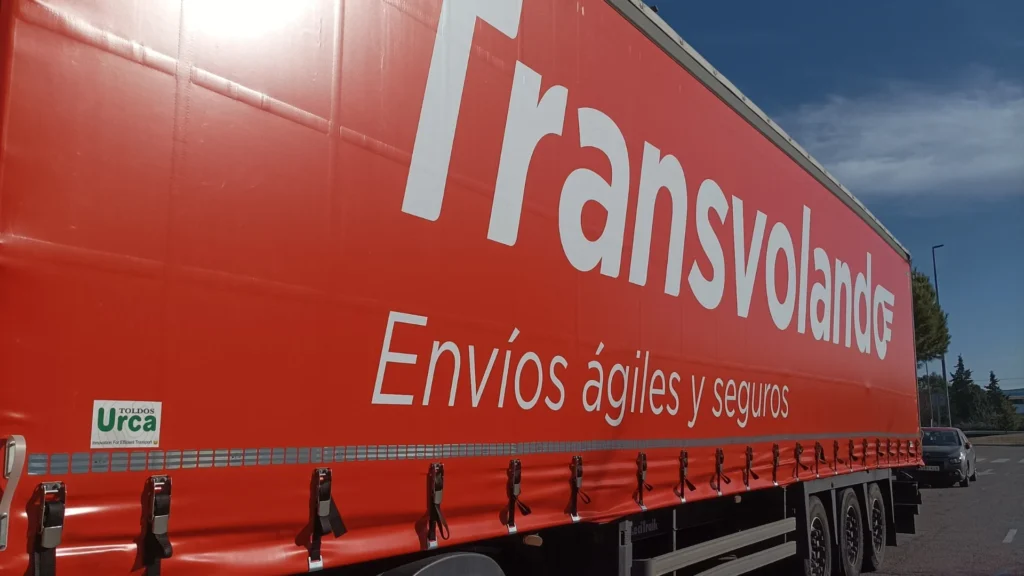
Heavy machinery transport is the road movement of industrial or construction equipment (typically indivisible) which, due to its weight and dimensions, requires load securing planning, appropriate loading equipment and, if it exceeds regulatory limits, an Abnormal Load Movement Authorisation (ACC) and specific route and timing conditions.
When a company searches for “heavy machinery transport”, it almost always needs one of these two things:
- To move bulky or heavy machinery (excavators, forklifts, access platforms, generators, industrial machinery, construction equipment, fairground/event equipment).
- To avoid risks and downtime caused by permits, access constraints, scheduling, loading equipment, or load securing.
Heavy machinery isn’t just about ‘weighing many tonnes’. It can also refer to ‘delicate loads’, ‘loads that are difficult to handle’ or ‘loads with complex support points’.
Key industry figures:
- ● Market volume in Spain: sector-specific data for road transport.
- ● Annual growth: annual growth (2024 estimate).
What type of vehicle is used to transport heavy machinery?
Heavy machinery is mainly transported using flatbed trailers, cranes or low-loader lorries, chosen according to the weight, height and type of machinery.
Types of heavy machinery transport by weight, dimensions and sector
Gondola transport
A low-loader is a low-bed semi-trailer designed to transport heavy or bulky machinery, making loading and unloading easier; it can be configured with between 2 and 10 axles depending on the load.
Typical capabilities
- Maximum weight: Payload approx. 72,750–127,900 lbs, deck height approx. 2.56–2.89 ft, extendable length up to 88.6–95.1 ft
- Dimensions: varies depending on the model and size
- types of gondola: low, extendable, modular
Ideal for
- Excavators
- Mobile cranes
- Heavy construction machinery.
Low-bed transport
Low-loader transport is a method similar to flatbed transport, designed for heavy machinery that cannot be dismantled and requires a platform very close to the ground in order to comply with height restrictions.
Transvolando uses reinforced flatbed trailers and modular/extendable flatbed trailers for machinery.
Typical Capacities
- Maximum weight: Up to 88,000–110,000 pounds (lbs)
- Dimensions: subject to regulations and the type of platform
Ideal for
- Self-propelled machinery
- Industrial high-reach equipment
- Transporte directo obra–obra o fabrica–obra
Approximate cost
- Similar to gondola transport, subject to permits and the complexity of the route.
Transport: Crane Truck
This is a service using a crane truck/self-loading lorry to load and unload without the need for external cranes, provided the weight and reach allow it. It is ideal for locations without lifting equipment or with limited access. It reduces coordination and downtime.
Typical capabilities
- Maximum load weight: limited by the crane's reach and capacity
- Uso habitual: medium-sized machinery, industrial equipment, heavy loads.
Ideal for
- Locations without lifting equipment
- Industrial or urban environments with limited access
- Projects that require a swift response.
Key advantage: Reduces the need for third-party coordination and minimises downtime.
Regulations and permits for the transport of heavy machinery in Spain (2026)
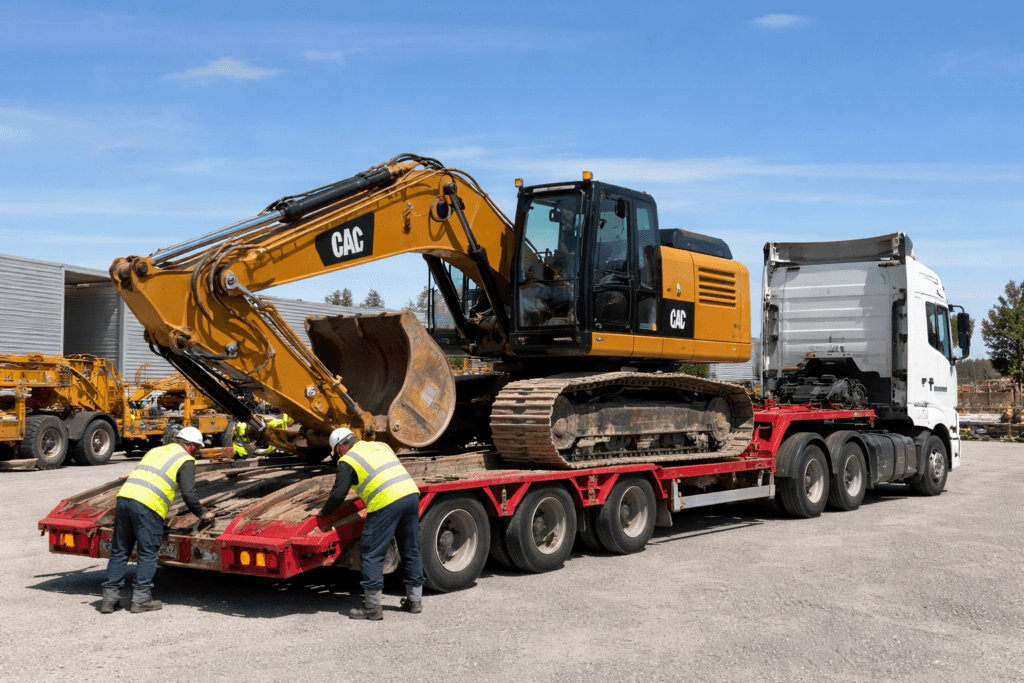
In Spain, the transport of heavy machinery requires special authorisation when it exceeds 44 t total weight or legal dimensions (2,55 m ancho, 4 m alto).
In such cases, it is mandatory to obtain permits and, in many instances, to carry out a route survey.
Legal limits in Spain
Comparison table:
| Parameter | General limit | With permission | Exceptional maximum |
| Total weight | 88,185 lbs | 132,277 lbs | 330,693 lbs |
| Width | 8.37 ft | 9.84 ft | 16.40 ft |
| High | 13.12 ft | 14.76 ft | 4,70 m |
| Long | 54.13 ft (articulated) / 61.52 ft (road train) | 67.42 ft | Over 97,000 lbs* |
*Requires specific research
Types of authorisations:
Generic Authorization
- Validity: 1 year renovable
- Applicable to: Transportes repetitivos en rutas similares
- Processing time: 15-30 dias
Specific Authorisation
- Validity: A once-in-a-lifetime trip
- Applicable to: Oversized loads
- Timing: 7–45 days (depending on the autonomous community)
How do I know which one I need?
- Measure the full combination “vehicle + load” (L×W×H and mass).
- If ≤20.55 × 3 × 4.5 m and ≤45 t → General ACC. .
- If it exceeds that but ≤40 × 5 × 4.70 m and ≤110 t → Specific ACC (and usually requires notifying the start of the journey).
- If it exceeds the above → ACC Excepcional.
If we contact us and confirm the measurements and weight (even if it’s only an approximation), I’ll tell you exactly which category the case falls into and how to draft it in the guide without any risk.
Required Documentation
Checklist completa:
- Supplementary Authorisation Traffic (if it exceeds regulatory limits or the route requires it)
- Control document transport.
- Insurance: Cargo insurance based on declared value and risk.
- Stowage/mooring plan and technical evidence where the case requires it.
- Declaration / Sheet Technical manufacturer's specifications (weight and dimensions)
- Feasibility and safety assessment road, if required by the ACC
- Escolta/pilotajor if the ACC so requires
- Intern Checklist: Check documentation and permits before proceeding.
Restrictions by autonomous community
In the case of special transport, there are no pre-established prohibited times set by the regional government: the conditions depend on the ACC, the authorised route and the road authority (the DGT, the SCT in Catalonia and local councils for urban sections).
At Madrid, the timings are governed by the Mobility Ordinance and vary depending on the type of permit.
The experience of. Transvolando its transport services have generally operated within the following time slots: Monday to Friday 23:00–06:00, Saturdays and the eve of public holidays 00:00–13:00, and public holidays 06:00–24:00; and for general permits on the M-30 at ground level/outside, it also allows 10:00–13:00 and 16:00–18:00.
At Cataluna The Mossos d'Esquadra must be notified at least 24 hours in advance for certain vehicle categories; therefore, it is important to check road traffic restrictions before setting off.
When is transport considered special or exceptional?
A consignment is classified as special transport when the vehicle and load together exceed the legal limits for weight, width, height or length set out in current regulations and cannot be split up without compromising their functionality.
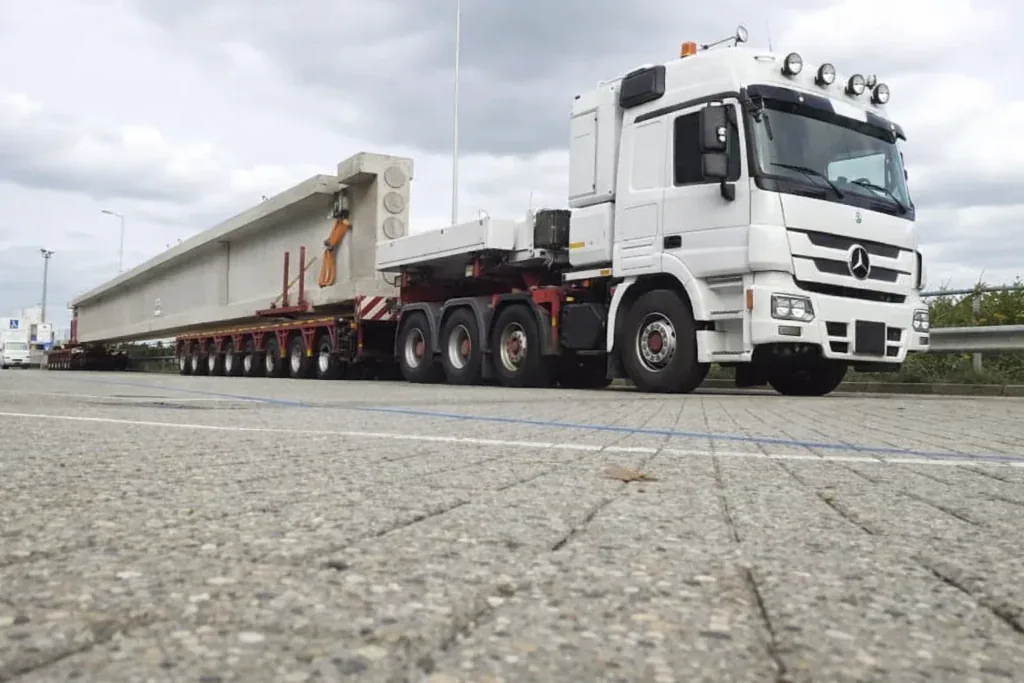
Classification by Dimensions and Permits
specialist transport Moderado
Dimensions:
- Largo: 20,55 m up to 40 m
- Ancho: 3 m up to 5 m
- Alto: superior a 4 m
Requirements:
- Abnormal Load Movement Authorisation (ACC)
- Route planning
- Pilot vehicle (where required)
- Restricted operating hours (if applicable)
Exceptional Special Transport
Dimensions:
- Length: over 40 m
- Width: over 5 m
- Height/Weight: extreme cases
Mandatory requirements:
- Specific ACC authorisation
- Detailed route survey
- Escort vehicles front and rear
- Coordination with authorities
- Special signage
Exceptional Special Transport
Dimensions:
- Length: over 40 m
- Width: over 5 m
- Height/Weight: extreme cases
Mandatory requirements:
- Specific ACC authorisation
- Detailed route survey
- Escort vehicles front and rear
- Coordination with authorities
- Special signage
General Transport
(No special authorisation required)
Permitted limits:
- Width: up to 2.55 m
- Height: up to 4.00 m
- Length: standard vehicle dimensions
✓ No special permits required
✓ Normal circulation
Cost of Heavy Machinery Transport in Spain
The cost of transporting heavy machinery can range from several hundred to several thousand euros, depending on the weight, dimensions, distance, required authorisations, and any specialised equipment needed.
Typical cost structure
Direct costs (operations):
- Base transport (km + operating time)
- Fuel (variable)
- Tolls (if applicable)
- Driver and operating hours
- Type of equipment required: ow loader / flatbed or extendable trailer / lorry-mounted crane / tail lift vehicle
- Loading/unloading equipment (external crane if required)
Indirect costs (planning and compliance):
- Permit/authorisation management (if limits are exceeded)
- Route survey (if there are constraints)
- Signage/marking and/or escort vehicles (if applicable)
- Additional insurance (if required due to value or risk)
Transvolando key point: the quotation is built using full technical information (dimensions/weight/access) to avoid additional charges afterwards.
Transport Calculator by Type of Service
Instead of €/km, use it as a decision tree::
A) Standard transport (light machinery / no oversize)
- Typical equipment: rigid lorry / standard trailer (depending on access) + tail lift if no handling equipment is available
- Key variables: km, time window, site access, need for self-unloading
B) Specialised transport (heavy machinery / possible oversize or complex access)
- Typical equipment: flatbed or extendable trailer, or low loader + possible lorry-mounted crane
- Key variables: exceeding width/height/length, turning radius, need for a load securing plan, permits
C) Exceptional transport (major oversize / advanced planning required)
- Quotation always tailored on a case-by-case basis
- Key variables: permits, route survey, night/municipal time restrictions, escort vehicles, critical infrastructure points
Hidden Costs to Watch Out For
Top 10 costs that can “appear” later
Waiting times and idle time
Cost: €50–150/hour
When: site not ready, coordination delays
How to avoid: strict planning + bilateral penalties
Unaccounted empty return journey
Cost: +30–50% of transport cost
When: one-way quotation only
How to avoid: confirm whether the quote includes return
Unforeseen municipal fees
- Cost: €100–500 per municipality
- Cuando: paso por ciertos ayuntamientos.
- Como evitar: estudio de ruta detallado.
Public road occupation permits
Cost: €200–1,000/day
When: loading/unloading in urban areas
How to avoid: apply for permits in advance
Temporary traffic modifications
- Cost: €500–3,000
- When: road closures, traffic lights relocation required
- How to avoid: time planning + alternative routes
Insufficient insurance cover
- Cost: +€200–1,000 for additional policy
- When: machinery value exceeds standard cover
- How to avoid: declare real value from the outset
Crane repositioning
- Cost: €150–400
- When: crane needs to be mobilised from another location
- How to avoid: coordinate with local providers
Combustible adicional por ruta no optima
- Cost: +10–20% above estimate
- When: detours or unforeseen restrictions
- How to avoid: professional route survey
Public holidays or weekends
- Cost: +25–50% above standard rate
- When: urgent jobs or poor planning
- How to avoid: plan 30+ days in advance
Damage not covered by insurance
- Cost: variable (€500–50,000+)
- When: exclusions in policy fine print
- How to avoid: review policy + pre-transport photo/video documentation
Common mistakes and how to avoid them
Real Comparative: Tranvolando Cases
1) Choosing based on price alone
➔ The cheapest option often ends up being more expensive due to extras (permits, cranes, waiting times).
➔ Avoid this by requesting a clearly defined scope: proposed vehicle, permits included/excluded, and written conditions.
2) Not verifying actual insurance cover
➔ Many quotations do not cover the declared value or include exclusions.
➔ Avoid this by declaring the value from the outset and confirming cover before loading.
3) Not validating route and access
➔ The main issue is usually access to the site/workshop (streets, turning radius, clearance height).
➔ Avoid this with an accessibility checklist and, where required, route planning/time windows.
4) Underestimating administrative timelines
➔ If there are dimensional or weight excesses, permits may affect dates and operating hours.
➔ Evitalo planificando con margen y confirmando requisitos antes de fijar the fecha.
5) Poor destination coordination
➔ The vehicle arrives and there is no crane, space, or responsible contact: delays and waiting times arise.
➔ Avoid this by planning ahead and confirming requirements before setting a date.
6) Not documenting the initial condition
➔ Without photos/videos before loading, any incident becomes disputable.
➔ Avoid this by recording condition and securing (photos before/after).
7) Using general hauliers for specialised loads
➔ In machinery transport, the difference lies in load securing, equipment, and coordination.
➔ Avoid this by working with an operator who manages the full operation (equipment + permits + coordination).
9. FAQ tecnicas
How long does a special transport take?
It depends on dimensions/weight, permits, access conditions and the route. As a general reference: from a few days (no permits required) to several weeks if authorisations and advanced planning are needed.
Is an escort/pilot vehicle always required?
No. Only if required by the authorisation or the route (due to dimensions, visibility, or critical points).
Can used machinery be transported?
Yes. The key is to have accurate weight/dimensions, photos, and valid securing/lashing points (or manufacturer guidelines).
What happens in case of a delay?
An incident protocol must be activated: immediate communication, safety assessment, and an updated ETA. The key is to minimise operational impact at the destination.
Who manages transport permits?
For machinery/special load operations, it is recommended that a specialised operator coordinates permits and traffic conditions as part of the service scope.
What weight is considered “heavy machinery” in Spain?
There is no single legal threshold. Operationally, it is usually considered “heavy” when it impacts the equipment and logistics (often from around 20 tonnes), and “special” when it exceeds standard limits or requires permits.
What permits do I need to transport industrial machinery?
It depends on whether the vehicle combination exceeds dimension/weight limits or if the route imposes specific conditions. With the technical data, it can be determined whether an authorisation is required and which type applies.
How much does it cost to transport heavy machinery per km?
There is no fixed price per kilometre. The cost depends on the equipment required (low loader/flatbed/lorry-mounted crane), permits, access conditions, time windows, and associated services. At Transvolando, each job is quoted on a case-by-case basis.
Ready to optimise your logistics with Transvolando?
Transvolando We are here to help you take your logistics to the next level. Whether you need fixed routes, machinery transport, groupage solutions, or any of our other services servicesWe are ready to offer you an efficient and secure service, tailored to your needs.
Request your personalised quote today and optimise your supply chain with Transvolando!
Cookies
We use cookies on our website to provide you with the most relevant experience by remembering your preferences and repeat visits. By clicking “Accept”, you consent to the use of ALL cookies. However, you may choose to reject them so that only strictly necessary cookies are enabled, or you can visit “Settings” to provide controlled consent. Política de cookiesAjustes Rechazar Aceptar
Basic information about cookies
Cookies policy
| Cookie | Duración | Descripción |
|---|---|---|
| CONSENT | 2 years | YouTube sets this cookie via embedded YouTube videos and records anonymous statistical data. |
| Cookie | Duración | Descripción |
|---|---|---|
| cookielawinfo-checkbox-advertisement | 1 year | Set by the GDPR Cookie Consent plugin, this cookie is used to record the user's consent for cookies in the "Ads" category. |
| cookielawinfo-checkbox-analytics | 11 months | This cookie is set by the GDPR cookie consent add-on. The cookie is used to store user consent for cookies in the "Analytics" category. |
| cookielawinfo-checkbox-functional | 11 months | The cookie is set by the GDPR cookie consent to register the user's consent to cookies in the "Functional" category. |
| cookielawinfo-checkbox-necessary | 11 months | This cookie is set by the RGPD cookie consent add-on. Cookies are used to store user consent for cookies in the "Required" category. |
| cookielawinfo-checkbox-others | 11 months | This cookie is set by the GDPR Cookie Consent plugin. The cookie is used to store the user's consent for cookies from the "Other" category. |
| cookielawinfo-checkbox-performance | 11 months | This cookie is set by the GDPR cookie consent add-on. The cookie is used to store user consent for cookies in the "Performance" category. |
| CookieLawInfoConsent | 1 year | Records the status of the default button of the corresponding category and the CCPA status. Works only in coordination with the primary cookie. |
| viewed_cookie_policy | 11 months | The cookie is set by the cookie consent add-on of the GDPR and is used to store whether or not the user has consented to the use of cookies. It does not store any personal data. |
| Cookie | Duración | Descripción |
|---|---|---|
| VISITOR_INFO1_LIVE | 5 months 27 days | Cookie set by YouTube to measure bandwidth that determines whether the user gets the new or the old player interface. |
| YSC | session | The YSC cookie is set by YouTube and is used to track the views of videos embedded in YouTube pages. |
| yt-remote-connected-devices | Never | YouTube sets this cookie to store the video preferences of the user using embedded YouTube video. |
| yt-remote-device-id | Never | YouTube sets this cookie to store the user's video preferences using the embedded YouTube video. |
| yt.innertube::nextId | Never | This cookie, set by YouTube, records a unique ID to store data about which YouTube videos the user has watched. |
| yt.innertube::requests | Never | This cookie, set by YouTube, records a unique ID to store data about which YouTube videos the user has watched. |
| Cookie | Duración | Descripción |
|---|---|---|
| CONSENT | 2 years | YouTube sets this cookie via embedded YouTube videos and records anonymous statistical data. |
| Cookie | Duración | Descripción |
|---|---|---|
| CONSENT | 2 years | YouTube sets this cookie via embedded YouTube videos and records anonymous statistical data. |
| Cookie | Duración | Descripción |
|---|---|---|
| CONSENT | 2 years | YouTube sets this cookie via embedded YouTube videos and records anonymous statistical data. |
| Cookie | Duración | Descripción |
|---|---|---|
| CONSENT | 2 years | YouTube sets this cookie via embedded YouTube videos and records anonymous statistical data. |
| Cookie | Duración | Descripción |
|---|---|---|
| CONSENT | 2 years | YouTube sets this cookie via embedded YouTube videos and records anonymous statistical data. |
| Cookie | Duración | Descripción |
|---|---|---|
| CONSENT | 2 years | YouTube sets this cookie via embedded YouTube videos and records anonymous statistical data. |
| Cookie | Duración | Descripción |
|---|---|---|
| VISITOR_INFO1_LIVE | 5 months 27 days | Cookie set by YouTube to measure bandwidth that determines whether the user gets the new or the old player interface. |
| YSC | session | The YSC cookie is set by YouTube and is used to track the views of videos embedded in YouTube pages. |
| yt-remote-connected-devices | Never | YouTube sets this cookie to store the video preferences of the user using embedded YouTube video. |
| yt-remote-device-id | Never | YouTube sets this cookie to store the user's video preferences using the embedded YouTube video. |
| yt.innertube::nextId | Never | This cookie, set by YouTube, records a unique ID to store data about which YouTube videos the user has watched. |
| yt.innertube::requests | Never | This cookie, set by YouTube, records a unique ID to store data about which YouTube videos the user has watched. |
| Cookie | Duración | Descripción |
|---|---|---|
| VISITOR_INFO1_LIVE | 5 months 27 days | Cookie set by YouTube to measure bandwidth that determines whether the user gets the new or the old player interface. |
| YSC | session | The YSC cookie is set by YouTube and is used to track the views of videos embedded in YouTube pages. |
| yt-remote-connected-devices | Never | YouTube sets this cookie to store the video preferences of the user using embedded YouTube video. |
| yt-remote-device-id | Never | YouTube sets this cookie to store the user's video preferences using the embedded YouTube video. |
| yt.innertube::nextId | Never | This cookie, set by YouTube, records a unique ID to store data about which YouTube videos the user has watched. |
| yt.innertube::requests | Never | This cookie, set by YouTube, records a unique ID to store data about which YouTube videos the user has watched. |
| Cookie | Duración | Descripción |
|---|---|---|
| VISITOR_INFO1_LIVE | 5 months 27 days | Cookie set by YouTube to measure bandwidth that determines whether the user gets the new or the old player interface. |
| YSC | session | The YSC cookie is set by YouTube and is used to track the views of videos embedded in YouTube pages. |
| yt-remote-connected-devices | Never | YouTube sets this cookie to store the video preferences of the user using embedded YouTube video. |
| yt-remote-device-id | Never | YouTube sets this cookie to store the user's video preferences using the embedded YouTube video. |
| yt.innertube::nextId | Never | This cookie, set by YouTube, records a unique ID to store data about which YouTube videos the user has watched. |
| yt.innertube::requests | Never | This cookie, set by YouTube, records a unique ID to store data about which YouTube videos the user has watched. |
| Cookie | Duración | Descripción |
|---|---|---|
| VISITOR_INFO1_LIVE | 5 months 27 days | Cookie set by YouTube to measure bandwidth that determines whether the user gets the new or the old player interface. |
| YSC | session | The YSC cookie is set by YouTube and is used to track the views of videos embedded in YouTube pages. |
| yt-remote-connected-devices | Never | YouTube sets this cookie to store the video preferences of the user using embedded YouTube video. |
| yt-remote-device-id | Never | YouTube sets this cookie to store the user's video preferences using the embedded YouTube video. |
| yt.innertube::nextId | Never | This cookie, set by YouTube, records a unique ID to store data about which YouTube videos the user has watched. |
| yt.innertube::requests | Never | This cookie, set by YouTube, records a unique ID to store data about which YouTube videos the user has watched. |
| Cookie | Duración | Descripción |
|---|---|---|
| VISITOR_INFO1_LIVE | 5 months 27 days | Cookie set by YouTube to measure bandwidth that determines whether the user gets the new or the old player interface. |
| YSC | session | The YSC cookie is set by YouTube and is used to track the views of videos embedded in YouTube pages. |
| yt-remote-connected-devices | Never | YouTube sets this cookie to store the video preferences of the user using embedded YouTube video. |
| yt-remote-device-id | Never | YouTube sets this cookie to store the user's video preferences using the embedded YouTube video. |
| yt.innertube::nextId | Never | This cookie, set by YouTube, records a unique ID to store data about which YouTube videos the user has watched. |
| yt.innertube::requests | Never | This cookie, set by YouTube, records a unique ID to store data about which YouTube videos the user has watched. |
| Cookie | Duración | Descripción |
|---|---|---|
| VISITOR_INFO1_LIVE | 5 months 27 days | Cookie set by YouTube to measure bandwidth that determines whether the user gets the new or the old player interface. |
| YSC | session | The YSC cookie is set by YouTube and is used to track the views of videos embedded in YouTube pages. |
| yt-remote-connected-devices | Never | YouTube sets this cookie to store the video preferences of the user using embedded YouTube video. |
| yt-remote-device-id | Never | YouTube sets this cookie to store the user's video preferences using the embedded YouTube video. |
| yt.innertube::nextId | Never | This cookie, set by YouTube, records a unique ID to store data about which YouTube videos the user has watched. |
| yt.innertube::requests | Never | This cookie, set by YouTube, records a unique ID to store data about which YouTube videos the user has watched. |
| Cookie | Duración | Descripción |
|---|---|---|
| cookielawinfo-checkbox-advertisement | 1 year | Set by the GDPR Cookie Consent plugin, this cookie is used to record the user's consent for cookies in the "Ads" category. |
| cookielawinfo-checkbox-analytics | 11 months | This cookie is set by the GDPR cookie consent add-on. The cookie is used to store user consent for cookies in the "Analytics" category. |
| cookielawinfo-checkbox-functional | 11 months | The cookie is set by the GDPR cookie consent to register the user's consent to cookies in the "Functional" category. |
| cookielawinfo-checkbox-necessary | 11 months | This cookie is set by the RGPD cookie consent add-on. Cookies are used to store user consent for cookies in the "Required" category. |
| cookielawinfo-checkbox-others | 11 months | This cookie is set by the GDPR Cookie Consent plugin. The cookie is used to store the user's consent for cookies from the "Other" category. |
| cookielawinfo-checkbox-performance | 11 months | This cookie is set by the GDPR cookie consent add-on. The cookie is used to store user consent for cookies in the "Performance" category. |
| CookieLawInfoConsent | 1 year | Records the status of the default button of the corresponding category and the CCPA status. Works only in coordination with the primary cookie. |
| viewed_cookie_policy | 11 months | The cookie is set by the cookie consent add-on of the GDPR and is used to store whether or not the user has consented to the use of cookies. It does not store any personal data. |
| Cookie | Duración | Descripción |
|---|---|---|
| cookielawinfo-checkbox-advertisement | 1 year | Set by the GDPR Cookie Consent plugin, this cookie is used to record the user's consent for cookies in the "Ads" category. |
| cookielawinfo-checkbox-analytics | 11 months | This cookie is set by the GDPR cookie consent add-on. The cookie is used to store user consent for cookies in the "Analytics" category. |
| cookielawinfo-checkbox-functional | 11 months | The cookie is set by the GDPR cookie consent to register the user's consent to cookies in the "Functional" category. |
| cookielawinfo-checkbox-necessary | 11 months | This cookie is set by the RGPD cookie consent add-on. Cookies are used to store user consent for cookies in the "Required" category. |
| cookielawinfo-checkbox-others | 11 months | This cookie is set by the GDPR Cookie Consent plugin. The cookie is used to store the user's consent for cookies from the "Other" category. |
| cookielawinfo-checkbox-performance | 11 months | This cookie is set by the GDPR cookie consent add-on. The cookie is used to store user consent for cookies in the "Performance" category. |
| CookieLawInfoConsent | 1 year | Records the status of the default button of the corresponding category and the CCPA status. Works only in coordination with the primary cookie. |
| viewed_cookie_policy | 11 months | The cookie is set by the cookie consent add-on of the GDPR and is used to store whether or not the user has consented to the use of cookies. It does not store any personal data. |
| Cookie | Duración | Descripción |
|---|---|---|
| cookielawinfo-checkbox-advertisement | 1 year | Set by the GDPR Cookie Consent plugin, this cookie is used to record the user's consent for cookies in the "Ads" category. |
| cookielawinfo-checkbox-analytics | 11 months | This cookie is set by the GDPR cookie consent add-on. The cookie is used to store user consent for cookies in the "Analytics" category. |
| cookielawinfo-checkbox-functional | 11 months | The cookie is set by the GDPR cookie consent to register the user's consent to cookies in the "Functional" category. |
| cookielawinfo-checkbox-necessary | 11 months | This cookie is set by the RGPD cookie consent add-on. Cookies are used to store user consent for cookies in the "Required" category. |
| cookielawinfo-checkbox-others | 11 months | This cookie is set by the GDPR Cookie Consent plugin. The cookie is used to store the user's consent for cookies from the "Other" category. |
| cookielawinfo-checkbox-performance | 11 months | This cookie is set by the GDPR cookie consent add-on. The cookie is used to store user consent for cookies in the "Performance" category. |
| CookieLawInfoConsent | 1 year | Records the status of the default button of the corresponding category and the CCPA status. Works only in coordination with the primary cookie. |
| viewed_cookie_policy | 11 months | The cookie is set by the cookie consent add-on of the GDPR and is used to store whether or not the user has consented to the use of cookies. It does not store any personal data. |
| Cookie | Duración | Descripción |
|---|---|---|
| cookielawinfo-checkbox-advertisement | 1 year | Set by the GDPR Cookie Consent plugin, this cookie is used to record the user's consent for cookies in the "Ads" category. |
| cookielawinfo-checkbox-analytics | 11 months | This cookie is set by the GDPR cookie consent add-on. The cookie is used to store user consent for cookies in the "Analytics" category. |
| cookielawinfo-checkbox-functional | 11 months | The cookie is set by the GDPR cookie consent to register the user's consent to cookies in the "Functional" category. |
| cookielawinfo-checkbox-necessary | 11 months | This cookie is set by the RGPD cookie consent add-on. Cookies are used to store user consent for cookies in the "Required" category. |
| cookielawinfo-checkbox-others | 11 months | This cookie is set by the GDPR Cookie Consent plugin. The cookie is used to store the user's consent for cookies from the "Other" category. |
| cookielawinfo-checkbox-performance | 11 months | This cookie is set by the GDPR cookie consent add-on. The cookie is used to store user consent for cookies in the "Performance" category. |
| CookieLawInfoConsent | 1 year | Records the status of the default button of the corresponding category and the CCPA status. Works only in coordination with the primary cookie. |
| viewed_cookie_policy | 11 months | The cookie is set by the cookie consent add-on of the GDPR and is used to store whether or not the user has consented to the use of cookies. It does not store any personal data. |
| Cookie | Duración | Descripción |
|---|---|---|
| cookielawinfo-checkbox-advertisement | 1 year | Set by the GDPR Cookie Consent plugin, this cookie is used to record the user's consent for cookies in the "Ads" category. |
| cookielawinfo-checkbox-analytics | 11 months | This cookie is set by the GDPR cookie consent add-on. The cookie is used to store user consent for cookies in the "Analytics" category. |
| cookielawinfo-checkbox-functional | 11 months | The cookie is set by the GDPR cookie consent to register the user's consent to cookies in the "Functional" category. |
| cookielawinfo-checkbox-necessary | 11 months | This cookie is set by the RGPD cookie consent add-on. Cookies are used to store user consent for cookies in the "Required" category. |
| cookielawinfo-checkbox-others | 11 months | This cookie is set by the GDPR Cookie Consent plugin. The cookie is used to store the user's consent for cookies from the "Other" category. |
| cookielawinfo-checkbox-performance | 11 months | This cookie is set by the GDPR cookie consent add-on. The cookie is used to store user consent for cookies in the "Performance" category. |
| CookieLawInfoConsent | 1 year | Records the status of the default button of the corresponding category and the CCPA status. Works only in coordination with the primary cookie. |
| viewed_cookie_policy | 11 months | The cookie is set by the cookie consent add-on of the GDPR and is used to store whether or not the user has consented to the use of cookies. It does not store any personal data. |
| Cookie | Duración | Descripción |
|---|---|---|
| cookielawinfo-checkbox-advertisement | 1 year | Set by the GDPR Cookie Consent plugin, this cookie is used to record the user's consent for cookies in the "Ads" category. |
| cookielawinfo-checkbox-analytics | 11 months | This cookie is set by the GDPR cookie consent add-on. The cookie is used to store user consent for cookies in the "Analytics" category. |
| cookielawinfo-checkbox-functional | 11 months | The cookie is set by the GDPR cookie consent to register the user's consent to cookies in the "Functional" category. |
| cookielawinfo-checkbox-necessary | 11 months | This cookie is set by the RGPD cookie consent add-on. Cookies are used to store user consent for cookies in the "Required" category. |
| cookielawinfo-checkbox-others | 11 months | This cookie is set by the GDPR Cookie Consent plugin. The cookie is used to store the user's consent for cookies from the "Other" category. |
| cookielawinfo-checkbox-performance | 11 months | This cookie is set by the GDPR cookie consent add-on. The cookie is used to store user consent for cookies in the "Performance" category. |
| CookieLawInfoConsent | 1 year | Records the status of the default button of the corresponding category and the CCPA status. Works only in coordination with the primary cookie. |
| viewed_cookie_policy | 11 months | The cookie is set by the cookie consent add-on of the GDPR and is used to store whether or not the user has consented to the use of cookies. It does not store any personal data. |