
Anything that goes over Spain’s standard road limits ends up on a heavy transport: excavators, cranes, industrial presses, generator sets, wind turbine blades, prefabricated factory modules, refinery components, transformers. If a normal trailer can’t take it, it lands in our operation.
This kind of freight isn’t its own category just because of the weight — it’s everything around it. Route planning takes days. Permits have to be approved by the DGT before the truck moves. Some loads need an escort, some need night-only travel, some need lane closures arranged with local authorities. Bridges and roundabouts that handle a normal lorry without thinking might not handle a 60-tonne low-loader.
We’ve also seen the cousin of this work plenty of times — heavy stand structures, lighting rigs and equipment heading into trade-fair halls like IFEMA, Bauma or Hannover Messe, where the venue’s loading dock only opens for 90 minutes on the build day. Same complexity, different deadline pressure.
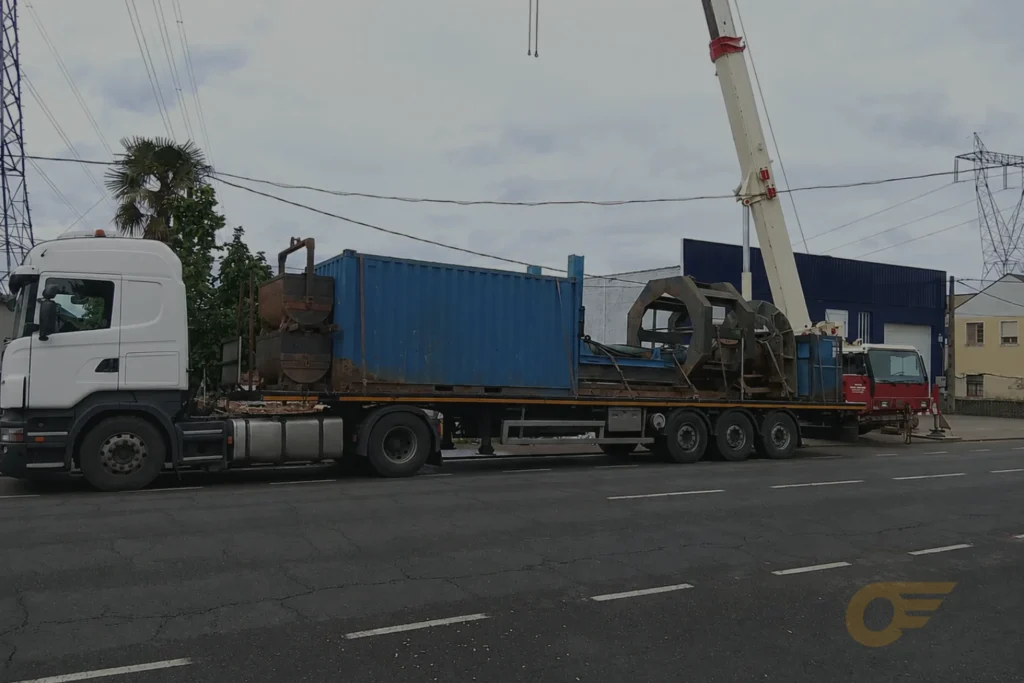
What changes when you hire a specialist for heavy machinery transport instead of a general carrier? Quite a lot, actually.
A general carrier tells you the trailer’s not available the day you need it. We’ll have an alternative ready before you ask. They quote without checking the route — and find out about the bridge restriction the morning of the collection. We do the route assessment before quoting, so the number you get is the number you pay. They send you a CMR copy two days after delivery. We send the POD scanned within the hour.
Our team handles route surveys, permit applications, escort vehicle booking, driver coordination, and customs paperwork when the load needs to leave Spain. One contact, one phone, one source of truth from quote to delivery. The way it should be.
Standard flatbed (platform trailer) — up to 26,000 kg, 13.6 m load length. Agricultural machinery, vehicles, smaller industrial kit. No permit needed if dimensions stay inside standard limits.
Low-loader (góndola / cama baja) — deck height 0.8 to 1.0 m. The standard choice for most abnormal loads. Heavy excavators, cranes, presses, industrial machinery up to 60 or 80 tonnes.
Extendable low-loader — extends to 36 m or more. For very long loads: wind turbine blades, bridge sections, long industrial components.
Self-loading crane truck (camión grúa) — for jobs where the destination has no forklift or crane available. Loads and unloads on its own. Common for machinery moves between factories without fixed lifting infrastructure, and also for trade-fair venues that won’t allow external lifting kit on the build day.
Multi-axle modular trailer — for the really heavy stuff. Transformers, mining equipment, refinery units. Custom configurations from 6 to 24+ axles depending on weight distribution.
Right vehicle depends on weight, dimensions, access at both ends and how the load needs to be tied down. Send us the specs and we’ll match it before quoting.
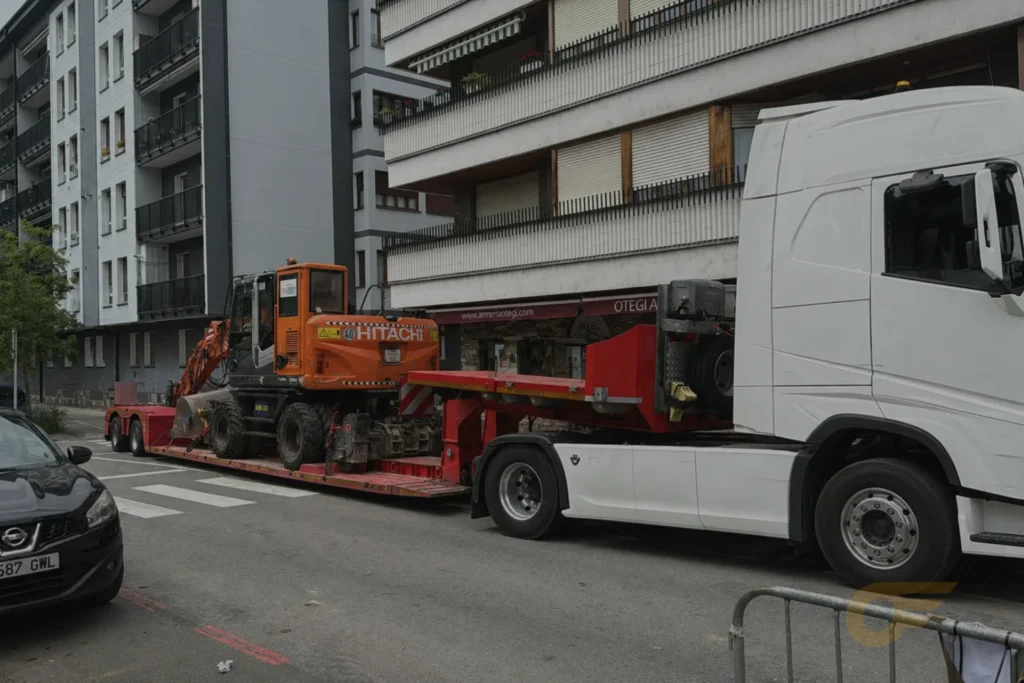
Any vehicle plus load combination that exceeds Spain’s standard road limits needs a special transport authorisation (autorización de transporte especial). The issuing body depends on where you’re going — the Dirección General de Carreteras for national roads, the regional authority for autonomous roads.
The numbers that define «standard» (no permit needed): up to 18.75 m long including tractor and trailer, 2.55 m wide, 4.00 m tall, 40 tonnes total gross weight (44 in some combinations). Cross any of those and the paperwork starts.
How long the permit takes depends on what you’re moving. Moderate abnormal — usually a few working days. Major abnormal — one to three weeks. Exceptional transport — a month or more if it needs route surveys and police escort scheduling. We file the application as soon as we have the cargo details, so the clock starts the moment you confirm.
Generic Authorisation (AG) — valid for 1 year, covers moderate abnormal loads on pre-approved routes. The most common permit for regular operators. Fast to obtain, low admin overhead.
Specific Authorisation (AE) — one-time permit for a single shipment, used when the load is more abnormal than the AG covers or when the route isn’t on the pre-approved list. Takes longer but gives you exactly what you need.
Police Escort Authorisation — required when dimensions, weight or route demand it. Coordinated with the Guardia Civil and local police forces. Adds time and cost but is non-negotiable when the load triggers it.
Which one applies depends on dimensions, weight, route and timing. We assess that before quoting — you get a single price covering the load plus all the permits it needs.
In Spain, a shipment becomes «special transport» (transporte especial) when the vehicle plus load exceeds the standard road limits: 2.55 m wide, 4.00 m tall, 18.75 m long, or 40 tonnes total weight (44 in some combinations).
Cross any of those numbers and you need an authorisation from the DGT, a planned route, and depending on how far over you go, escort vehicles. Standard transport runs on any road, any day. Special transport runs only on approved routes, often only at specific hours, sometimes only at night. The bigger the load, the more constraints stack up.
We handle the full authorisation process — application, route approval, scheduling, escort booking — so you don’t need to learn the DGT paperwork yourself.
Standard transport — up to 18.75 m / 2.55 m / 4.00 m / 40 tonnes. No permits, no escort, no route restrictions.
Moderate abnormal — 2.55 to 3.00 m wide, 4.00 to 4.50 m tall, up to 60 tonnes. Basic authorisation, no escort in most cases, route planning required.
Major abnormal — 3.00 to 5.00 m wide, 4.50 to 5.00 m tall, 60 to 100 tonnes. Special permit, one or two escort vehicles, restricted routes, often night-only travel.
Exceptional transport — over 5.00 m wide, over 100 tonnes, or unusual configurations. Custom authorisation, full police escort, dedicated route with possible road closures, specialist coordination weeks in advance.
Knowing which category you fall into changes everything — the trailer, the timeline, the cost, the paperwork. Send us the dimensions and we’ll tell you which bracket you’re in within the same business day.
Heavy machinery transport prices vary enormously — there’s no single per-km figure that means much. What drives the cost: weight, dimensions, route, permits, escort needs, access at both ends, and how urgent the move is.
Some rough guides for moderate abnormal loads inside Spain: €1.80–3.50/km depending on weight and escort. A typical excavator move across central Spain (300–500 km) tends to sit in €1,200–2,500 range. Cross-border to Germany or the UK adds €1,500–4,000 in fixed costs on top of distance — permits, port crossings, customs paperwork.
Major abnormal loads (over 60 t or oversize) are different territory — pricing is custom and depends on the specific route and authorisations needed. We quote those individually after route assessment.
Send us dimensions, weight, origin, destination and rough date — we come back with a real number within 24 hours, not a templated estimate.
Not measuring the load accurately: Even a few centimetres can change the permit category. Always provide exact dimensions (length, width, height) and total weight including the transport vehicle.
Underestimating permit lead times: Generic permits take 48–72 hours. Specific permits take 5–15 working days. Exceptional movements can take a month or more. Plan ahead.
Overlooking regional restrictions: Each autonomous community in Spain can impose additional restrictions on timing, routes or escort requirements. A permit from the national authority is not always sufficient.
Using the wrong vehicle type: Choosing the wrong trailer (standard flatbed vs. low-loader vs. self-propelled modular transporter) leads to safety issues or permit rejections.
Depends on dimensions, weight, permits and the route. Quick version: a few days if no permits are needed, several weeks if you need authorisations and advanced planning. Once we see the specs we can usually give you an accurate timeline within 24 hours.
No — only if the authorisation or the route specifically requires it. Tight corners, low bridges or busy stretches near urban areas usually trigger a pilot vehicle. Open motorway runs in standard moderate-abnormal range rarely need one.
Yes, no problem. What we need from you: real weight and dimensions, photos, valid lashing or tie-down points (or manufacturer instructions). Used machinery actually makes up most of what we move — secondhand combines, lifts, factory equipment going to new sites.
Our incident protocol kicks in straight away: immediate call to you, safety assessment, ETA update for the consignee. The aim is to minimise impact on the receiving site. We don’t disappear and hope it sorts itself out — we tell you what’s happening and what we’re doing about it.
We do. For heavy machinery and special loads, the operator handling the shipment manages the permits — that’s the whole point of hiring a specialist. We coordinate with DGT, file the paperwork and confirm routes before the truck moves.
Spain doesn’t have a single legal threshold for «heavy». Operationally, machinery starts counting as heavy when it dictates the equipment and operation — typically from around 24 tonnes upwards, or when standard trailer dimensions don’t fit. Below that you’re in standard FTL territory.
Depends on dimensions and weight. Below standard limits — no permit. Moderate abnormal (slightly over standard) needs a basic authorisation. Major abnormal (high tonnage, oversized loads) requires special permits, route approval and sometimes escort. We handle the full permit process when we manage the shipment.
Hard to give one figure — costs vary too much by load and route. Rough guides for moderate abnormal loads in Spain: €1.80–3.50/km depending on weight, escort and access. For UK or Germany cross-border, factor in €1,500–4,000 fixed costs on top of distance — permits, ports, customs.
Transvolando manages heavy and abnormal load transport across Spain and into Europe. Tell us your cargo dimensions, weight and route — we will handle permits, escort coordination, route surveys and delivery. Response within 2 business hours.
Request your personalized quote today and optimize your supply chain!
B2B freight from Spain across Europe. Network of vetted carriers, single account manager and CMR cover up to 150,000 euros. Quote in 2 business hours.
| Cookie | Duration | Description |
|---|---|---|
| CONSENT | 2 years | YouTube sets this cookie via embedded YouTube videos and records anonymous statistical data. |
| Cookie | Duration | Description |
|---|---|---|
| cookielawinfo-checkbox-advertisement | 1 year | Set by the GDPR Cookie Consent plugin, this cookie is used to record user consent for cookies in the "Ads" category. |
| cookielawinfo-checkbox-analytics | 11 months | This cookie is set by the GDPR Cookie Consent Plugin. The cookie is used to store the user's consent for cookies in the "Analytics" category. |
| cookielawinfo-checkbox-functional | 11 months | The cookie is set by GDPR cookie consent to record user consent for cookies in the "Functional" category. |
| cookielawinfo-checkbox-necessary | 11 months | This cookie is set by the GDPR Cookie Consent Plugin. Cookies are used to store user consent for cookies in the "Necessary" category. |
| cookielawinfo-checkbox-others | 11 months | This cookie is set by the GDPR Cookie Consent plugin. The cookie is used to store the user's consent for cookies in the "Other" category. |
| cookielawinfo-checkbox-performance | 11 months | This cookie is set by the GDPR Cookie Consent Plugin. The cookie is used to store user consent for cookies in the "Performance" category. |
| CookieLawInfoConsent | 1 year | Records the default button state of the corresponding category and the CCPA state. It works only in coordination with the primary cookie. |
| viewed_cookie_policy | 11 months | The cookie is set by the GDPR cookie consent plugin and is used to store whether or not the user has consented to the use of cookies. It does not store any personal data. |
| Cookie | Duration | Description |
|---|---|---|
| VISITOR_INFO1_LIVE | 5 months 27 days | Cookie set by YouTube to measure bandwidth that determines whether the user gets the new or old player interface. |
| YSC | session | The YSC cookie is installed by YouTube and is used to track views of videos embedded on YouTube pages. |
| yt-remote-connected-devices | Never | YouTube sets this cookie to store the video preferences of the user who uses embedded YouTube video. |
| yt-remote-device-id | Never | YouTube sets this cookie to store the user's video preferences using the embedded YouTube video. |
| yt.innertube::nextId | Never | This cookie, installed by YouTube, registers a unique ID to store data about which YouTube videos the user has watched. |
| yt.innertube::requests | Never | This cookie, installed by YouTube, registers a unique ID to store data about which YouTube videos the user has watched. |
| Cookie | Duration | Description |
|---|---|---|
| CONSENT | 2 years | YouTube sets this cookie via embedded YouTube videos and records anonymous statistical data. |
| Cookie | Duration | Description |
|---|---|---|
| CONSENT | 2 years | YouTube sets this cookie via embedded YouTube videos and records anonymous statistical data. |
| Cookie | Duration | Description |
|---|---|---|
| CONSENT | 2 years | YouTube sets this cookie via embedded YouTube videos and records anonymous statistical data. |
| Cookie | Duration | Description |
|---|---|---|
| CONSENT | 2 years | YouTube sets this cookie via embedded YouTube videos and records anonymous statistical data. |
| Cookie | Duration | Description |
|---|---|---|
| CONSENT | 2 years | YouTube sets this cookie via embedded YouTube videos and records anonymous statistical data. |
| Cookie | Duration | Description |
|---|---|---|
| CONSENT | 2 years | YouTube sets this cookie via embedded YouTube videos and records anonymous statistical data. |
| Cookie | Duration | Description |
|---|---|---|
| VISITOR_INFO1_LIVE | 5 months 27 days | Cookie set by YouTube to measure bandwidth that determines whether the user gets the new or old player interface. |
| YSC | session | The YSC cookie is installed by YouTube and is used to track views of videos embedded on YouTube pages. |
| yt-remote-connected-devices | Never | YouTube sets this cookie to store the video preferences of the user who uses embedded YouTube video. |
| yt-remote-device-id | Never | YouTube sets this cookie to store the user's video preferences using the embedded YouTube video. |
| yt.innertube::nextId | Never | This cookie, installed by YouTube, registers a unique ID to store data about which YouTube videos the user has watched. |
| yt.innertube::requests | Never | This cookie, installed by YouTube, registers a unique ID to store data about which YouTube videos the user has watched. |
| Cookie | Duration | Description |
|---|---|---|
| VISITOR_INFO1_LIVE | 5 months 27 days | Cookie set by YouTube to measure bandwidth that determines whether the user gets the new or old player interface. |
| YSC | session | The YSC cookie is installed by YouTube and is used to track views of videos embedded on YouTube pages. |
| yt-remote-connected-devices | Never | YouTube sets this cookie to store the video preferences of the user who uses embedded YouTube video. |
| yt-remote-device-id | Never | YouTube sets this cookie to store the user's video preferences using the embedded YouTube video. |
| yt.innertube::nextId | Never | This cookie, installed by YouTube, registers a unique ID to store data about which YouTube videos the user has watched. |
| yt.innertube::requests | Never | This cookie, installed by YouTube, registers a unique ID to store data about which YouTube videos the user has watched. |
| Cookie | Duration | Description |
|---|---|---|
| VISITOR_INFO1_LIVE | 5 months 27 days | Cookie set by YouTube to measure bandwidth that determines whether the user gets the new or old player interface. |
| YSC | session | The YSC cookie is installed by YouTube and is used to track views of videos embedded on YouTube pages. |
| yt-remote-connected-devices | Never | YouTube sets this cookie to store the video preferences of the user who uses embedded YouTube video. |
| yt-remote-device-id | Never | YouTube sets this cookie to store the user's video preferences using the embedded YouTube video. |
| yt.innertube::nextId | Never | This cookie, installed by YouTube, registers a unique ID to store data about which YouTube videos the user has watched. |
| yt.innertube::requests | Never | This cookie, installed by YouTube, registers a unique ID to store data about which YouTube videos the user has watched. |
| Cookie | Duration | Description |
|---|---|---|
| VISITOR_INFO1_LIVE | 5 months 27 days | Cookie set by YouTube to measure bandwidth that determines whether the user gets the new or old player interface. |
| YSC | session | The YSC cookie is installed by YouTube and is used to track views of videos embedded on YouTube pages. |
| yt-remote-connected-devices | Never | YouTube sets this cookie to store the video preferences of the user who uses embedded YouTube video. |
| yt-remote-device-id | Never | YouTube sets this cookie to store the user's video preferences using the embedded YouTube video. |
| yt.innertube::nextId | Never | This cookie, installed by YouTube, registers a unique ID to store data about which YouTube videos the user has watched. |
| yt.innertube::requests | Never | This cookie, installed by YouTube, registers a unique ID to store data about which YouTube videos the user has watched. |
| Cookie | Duration | Description |
|---|---|---|
| VISITOR_INFO1_LIVE | 5 months 27 days | Cookie set by YouTube to measure bandwidth that determines whether the user gets the new or old player interface. |
| YSC | session | The YSC cookie is installed by YouTube and is used to track views of videos embedded on YouTube pages. |
| yt-remote-connected-devices | Never | YouTube sets this cookie to store the video preferences of the user who uses embedded YouTube video. |
| yt-remote-device-id | Never | YouTube sets this cookie to store the user's video preferences using the embedded YouTube video. |
| yt.innertube::nextId | Never | This cookie, installed by YouTube, registers a unique ID to store data about which YouTube videos the user has watched. |
| yt.innertube::requests | Never | This cookie, installed by YouTube, registers a unique ID to store data about which YouTube videos the user has watched. |
| Cookie | Duration | Description |
|---|---|---|
| VISITOR_INFO1_LIVE | 5 months 27 days | Cookie set by YouTube to measure bandwidth that determines whether the user gets the new or old player interface. |
| YSC | session | The YSC cookie is installed by YouTube and is used to track views of videos embedded on YouTube pages. |
| yt-remote-connected-devices | Never | YouTube sets this cookie to store the video preferences of the user who uses embedded YouTube video. |
| yt-remote-device-id | Never | YouTube sets this cookie to store the user's video preferences using the embedded YouTube video. |
| yt.innertube::nextId | Never | This cookie, installed by YouTube, registers a unique ID to store data about which YouTube videos the user has watched. |
| yt.innertube::requests | Never | This cookie, installed by YouTube, registers a unique ID to store data about which YouTube videos the user has watched. |
| Cookie | Duration | Description |
|---|---|---|
| cookielawinfo-checkbox-advertisement | 1 year | Set by the GDPR Cookie Consent plugin, this cookie is used to record user consent for cookies in the "Ads" category. |
| cookielawinfo-checkbox-analytics | 11 months | This cookie is set by the GDPR Cookie Consent Plugin. The cookie is used to store the user's consent for cookies in the "Analytics" category. |
| cookielawinfo-checkbox-functional | 11 months | The cookie is set by GDPR cookie consent to record user consent for cookies in the "Functional" category. |
| cookielawinfo-checkbox-necessary | 11 months | This cookie is set by the GDPR Cookie Consent Plugin. Cookies are used to store user consent for cookies in the "Necessary" category. |
| cookielawinfo-checkbox-others | 11 months | This cookie is set by the GDPR Cookie Consent plugin. The cookie is used to store the user's consent for cookies in the "Other" category. |
| cookielawinfo-checkbox-performance | 11 months | This cookie is set by the GDPR Cookie Consent Plugin. The cookie is used to store user consent for cookies in the "Performance" category. |
| CookieLawInfoConsent | 1 year | Records the default button state of the corresponding category and the CCPA state. It works only in coordination with the primary cookie. |
| viewed_cookie_policy | 11 months | The cookie is set by the GDPR cookie consent plugin and is used to store whether or not the user has consented to the use of cookies. It does not store any personal data. |
| Cookie | Duration | Description |
|---|---|---|
| cookielawinfo-checkbox-advertisement | 1 year | Set by the GDPR Cookie Consent plugin, this cookie is used to record user consent for cookies in the "Ads" category. |
| cookielawinfo-checkbox-analytics | 11 months | This cookie is set by the GDPR Cookie Consent Plugin. The cookie is used to store the user's consent for cookies in the "Analytics" category. |
| cookielawinfo-checkbox-functional | 11 months | The cookie is set by GDPR cookie consent to record user consent for cookies in the "Functional" category. |
| cookielawinfo-checkbox-necessary | 11 months | This cookie is set by the GDPR Cookie Consent Plugin. Cookies are used to store user consent for cookies in the "Necessary" category. |
| cookielawinfo-checkbox-others | 11 months | This cookie is set by the GDPR Cookie Consent plugin. The cookie is used to store the user's consent for cookies in the "Other" category. |
| cookielawinfo-checkbox-performance | 11 months | This cookie is set by the GDPR Cookie Consent Plugin. The cookie is used to store user consent for cookies in the "Performance" category. |
| CookieLawInfoConsent | 1 year | Records the default button state of the corresponding category and the CCPA state. It works only in coordination with the primary cookie. |
| viewed_cookie_policy | 11 months | The cookie is set by the GDPR cookie consent plugin and is used to store whether or not the user has consented to the use of cookies. It does not store any personal data. |
| Cookie | Duration | Description |
|---|---|---|
| cookielawinfo-checkbox-advertisement | 1 year | Set by the GDPR Cookie Consent plugin, this cookie is used to record user consent for cookies in the "Ads" category. |
| cookielawinfo-checkbox-analytics | 11 months | This cookie is set by the GDPR Cookie Consent Plugin. The cookie is used to store the user's consent for cookies in the "Analytics" category. |
| cookielawinfo-checkbox-functional | 11 months | The cookie is set by GDPR cookie consent to record user consent for cookies in the "Functional" category. |
| cookielawinfo-checkbox-necessary | 11 months | This cookie is set by the GDPR Cookie Consent Plugin. Cookies are used to store user consent for cookies in the "Necessary" category. |
| cookielawinfo-checkbox-others | 11 months | This cookie is set by the GDPR Cookie Consent plugin. The cookie is used to store the user's consent for cookies in the "Other" category. |
| cookielawinfo-checkbox-performance | 11 months | This cookie is set by the GDPR Cookie Consent Plugin. The cookie is used to store user consent for cookies in the "Performance" category. |
| CookieLawInfoConsent | 1 year | Records the default button state of the corresponding category and the CCPA state. It works only in coordination with the primary cookie. |
| viewed_cookie_policy | 11 months | The cookie is set by the GDPR cookie consent plugin and is used to store whether or not the user has consented to the use of cookies. It does not store any personal data. |
| Cookie | Duration | Description |
|---|---|---|
| cookielawinfo-checkbox-advertisement | 1 year | Set by the GDPR Cookie Consent plugin, this cookie is used to record user consent for cookies in the "Ads" category. |
| cookielawinfo-checkbox-analytics | 11 months | This cookie is set by the GDPR Cookie Consent Plugin. The cookie is used to store the user's consent for cookies in the "Analytics" category. |
| cookielawinfo-checkbox-functional | 11 months | The cookie is set by GDPR cookie consent to record user consent for cookies in the "Functional" category. |
| cookielawinfo-checkbox-necessary | 11 months | This cookie is set by the GDPR Cookie Consent Plugin. Cookies are used to store user consent for cookies in the "Necessary" category. |
| cookielawinfo-checkbox-others | 11 months | This cookie is set by the GDPR Cookie Consent plugin. The cookie is used to store the user's consent for cookies in the "Other" category. |
| cookielawinfo-checkbox-performance | 11 months | This cookie is set by the GDPR Cookie Consent Plugin. The cookie is used to store user consent for cookies in the "Performance" category. |
| CookieLawInfoConsent | 1 year | Records the default button state of the corresponding category and the CCPA state. It works only in coordination with the primary cookie. |
| viewed_cookie_policy | 11 months | The cookie is set by the GDPR cookie consent plugin and is used to store whether or not the user has consented to the use of cookies. It does not store any personal data. |
| Cookie | Duration | Description |
|---|---|---|
| cookielawinfo-checkbox-advertisement | 1 year | Set by the GDPR Cookie Consent plugin, this cookie is used to record user consent for cookies in the "Ads" category. |
| cookielawinfo-checkbox-analytics | 11 months | This cookie is set by the GDPR Cookie Consent Plugin. The cookie is used to store the user's consent for cookies in the "Analytics" category. |
| cookielawinfo-checkbox-functional | 11 months | The cookie is set by GDPR cookie consent to record user consent for cookies in the "Functional" category. |
| cookielawinfo-checkbox-necessary | 11 months | This cookie is set by the GDPR Cookie Consent Plugin. Cookies are used to store user consent for cookies in the "Necessary" category. |
| cookielawinfo-checkbox-others | 11 months | This cookie is set by the GDPR Cookie Consent plugin. The cookie is used to store the user's consent for cookies in the "Other" category. |
| cookielawinfo-checkbox-performance | 11 months | This cookie is set by the GDPR Cookie Consent Plugin. The cookie is used to store user consent for cookies in the "Performance" category. |
| CookieLawInfoConsent | 1 year | Records the default button state of the corresponding category and the CCPA state. It works only in coordination with the primary cookie. |
| viewed_cookie_policy | 11 months | The cookie is set by the GDPR cookie consent plugin and is used to store whether or not the user has consented to the use of cookies. It does not store any personal data. |
| Cookie | Duration | Description |
|---|---|---|
| cookielawinfo-checkbox-advertisement | 1 year | Set by the GDPR Cookie Consent plugin, this cookie is used to record user consent for cookies in the "Ads" category. |
| cookielawinfo-checkbox-analytics | 11 months | This cookie is set by the GDPR Cookie Consent Plugin. The cookie is used to store the user's consent for cookies in the "Analytics" category. |
| cookielawinfo-checkbox-functional | 11 months | The cookie is set by GDPR cookie consent to record user consent for cookies in the "Functional" category. |
| cookielawinfo-checkbox-necessary | 11 months | This cookie is set by the GDPR Cookie Consent Plugin. Cookies are used to store user consent for cookies in the "Necessary" category. |
| cookielawinfo-checkbox-others | 11 months | This cookie is set by the GDPR Cookie Consent plugin. The cookie is used to store the user's consent for cookies in the "Other" category. |
| cookielawinfo-checkbox-performance | 11 months | This cookie is set by the GDPR Cookie Consent Plugin. The cookie is used to store user consent for cookies in the "Performance" category. |
| CookieLawInfoConsent | 1 year | Records the default button state of the corresponding category and the CCPA state. It works only in coordination with the primary cookie. |
| viewed_cookie_policy | 11 months | The cookie is set by the GDPR cookie consent plugin and is used to store whether or not the user has consented to the use of cookies. It does not store any personal data. |
