Last updated: April 2026. Shipping goods between the UK and Spain by road is one of the most common freight lanes in Europe — and also one of the most misunderstood since Brexit. This guide walks UK shippers through transit times, paperwork, pricing, and the decisions that decide whether a consignment lands on time and within budget, or loses three days at Dover.
It’s written from the Madrid side of the lane — our operation runs out of Getafe (south of Madrid) and coordinates collections across Spain and deliveries into the UK every working day. The figures and timings here come from live routes in 2026, not generic estimates.
Who this guide is for
This is written for UK-based freight buyers, logistics managers and SME owners who move product between the UK and Spain — usually one or more of these:
- Manufacturers shipping components or finished goods to Spanish customers
- Retailers and distributors handling Spanish suppliers (fresh produce, wine, fashion, automotive)
- Construction and energy firms moving plant or equipment
- Event and exhibition organisers with Madrid, Barcelona or Valencia venues
- Anyone who’s been burnt by a haulier overpromising transit times or underquoting on paperwork
How UK–Spain road freight actually works
Road is the dominant mode: roughly three-quarters of goods moving between the UK and Spain travel on a lorry, typically via the Dover–Calais ferry or the Eurotunnel (Folkestone–Coquelles), then down through France via the A10 and A63 into Spain.
The route splits in practice into four legs:
- Collection in the UK — pickup from origin (factory, warehouse, port) with the correct trailer type (tautliner for palletised, box trailer for secure or temperature-sensitive, lowboy for machinery)
- Channel crossing — Dover ferry (90 min) or Eurotunnel shuttle (35 min). Booking windows matter: peak times (Mondays and Friday afternoons) add queue time
- French transit — ~10-12 h driving Calais→Bordeaux→Spanish border, constrained by EU tachograph rules (9h drive / 11h rest cycle)
- Spanish final mile — delivery from the border into Madrid, Barcelona, Valencia or beyond. Spanish road network is modern; what usually kills the timing is site access and delivery windows
Transit times: what’s realistic in 2026
Realistic end-to-end lead times for full-load road freight UK→Madrid (collection to delivery):
| Service level | UK origin → Madrid | Notes |
|---|---|---|
| Standard FTL (single driver) | 3–4 working days | Tachograph-compliant, no rush |
| Express FTL (double-manned) | 2 working days | Two drivers take turns — almost non-stop |
| Dedicated urgent | 36–48 hours | Premium rate, booking priority on Channel |
| Groupage (part-load) | 4–6 working days | Consolidation + deconsolidation add 1-2 days |
Add 24–48 hours if your cargo requires customs inspection at UK or Spanish border, which happens on a random sample of consignments plus any that trigger flags (high-value, dutiable, first-time EORI, etc.).
Post-Brexit documentation: what you actually need
Since 1 January 2021 the UK is outside the EU customs union, so every road shipment between the UK and Spain is a formal export/import. The three documents that matter on the road side:
| Document | Purpose | Who issues it |
|---|---|---|
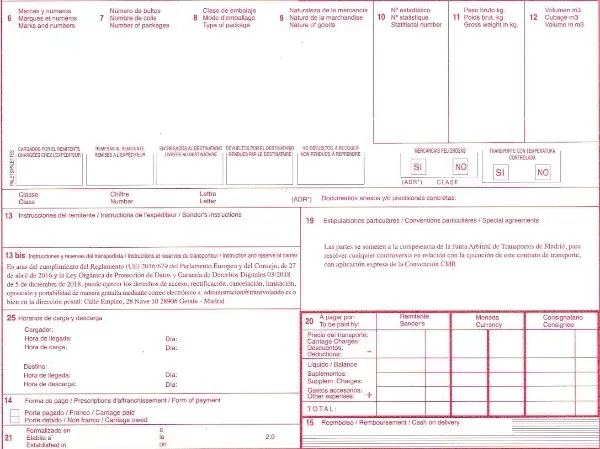
| CMR consignment note | Legal contract of carriage between sender, carrier and consignee — defines liability and cargo details | Carrier (or agency on their behalf) |
| T1 transit document | Customs transit doc that lets goods cross EU territory under bond without paying import duty until final destination | Customs agent / freight forwarder |
| EORI number | Economic Operator ID required for both sender and consignee to move goods across the UK–EU border | Applied for via HMRC (UK) or AEAT (Spain) |
Other documents depending on cargo: commercial invoice, packing list, certificate of origin (REX for UK-originating goods claiming preferential tariff), ADR declaration for dangerous goods, health certificates for food/plants, and ACC permit for abnormal loads.
For detail on the CMR consignment note itself, see our separate guide to the CMR Convention.
FTL vs groupage: pricing and when to choose which
The right answer depends on volume, urgency and how much control you want. Orientative UK→Madrid prices for 2026, excluding VAT and customs fees:
| Scenario | Indicative price (€) | When it fits |
|---|---|---|
| Groupage 1–5 euro pallets | €280–€900 | Small consignment, no rush, no temperature needs |
| Groupage 6–15 euro pallets | €1.100–€2.400 | Mid-size shipment, flexible delivery window |
| FTL standard (up to 33 euro pallets) | €3.750–€4.100 to Greater London | Full-load or part-load where control beats cost |
| FTL standard to West Midlands | €3.950–€4.200 | Birmingham, Wolverhampton, Coventry area |
| FTL standard to North West / Yorkshire | €4.100–€4.600 | Manchester, Liverpool, Leeds, Sheffield |
| FTL standard to North / Scotland | From €4.700 | Newcastle, Edinburgh, Glasgow and further north |
| Express FTL (double-manned) | +20–35% on standard FTL | Production line stoppage, event delivery, fresh produce |
Indicative 2026 prices. The final price depends on cargo dimensions, permits, urgency, return-leg availability and seasonality (peak weeks September–October and November–December). Every case is quoted individually.
Rule of thumb: if you’re moving over 10 linear metres or more than 10 euro pallets and the cargo is time-sensitive, a dedicated FTL usually beats groupage on total cost once you factor in damage risk, re-handling and delay surcharges. Under that, groupage saves 30–60% depending on volume.
Five mistakes UK shippers make on this lane (and how to avoid them)
1. Underestimating Channel queue time at Dover
On a Friday afternoon in July you can add 4-6 hours to the crossing window easily. Book early, avoid peak windows, and ask your carrier which ferry operator they’ve got priority with.
2. Treating the CMR as paperwork rather than protection
If the CMR note is vague on cargo condition at pickup, you’ve no leg to stand on for a damage claim at delivery. Photograph cargo at collection, note any existing damage on the CMR, insist on the consignee signing at delivery with reservations if anything’s off.
3. Quoting on rate only, ignoring return-leg realities
A UK→Spain leg is typically 20-30% cheaper than Spain→UK because of trade-balance empty running on the return. If you’re buying based on pure rate you might end up with a haulier who disappears when it’s time to pick up your return. A good agency balances both legs.
4. Under-specifying the site access at delivery
Spanish industrial estates often have narrow turning circles, time-restricted access in city centres, or no loading dock at all. Specify site conditions up front — tail-lift needed, forklift on site, crane booked, time window — or you’ll pay standstill charges.
5. Ignoring the HGV driver shortage
Both the UK (Brexit-related) and Spain (ageing workforce, average haulier age over 50) are short on drivers. In peak weeks availability tightens and rates jump. Book ahead, keep a roster of preferred carriers, and don’t leave the quote until the last minute.
When you need specialist transport instead
Standard tautliner FTL covers the vast majority of UK–Spain freight, but some cargo needs more:
- Abnormal loads (over 2.55 m wide, 4 m tall, or 44 tonnes): lowboy or extendable trailer, ACC permit, potentially escort. More on abnormal loads here
- Industrial machinery (CNC, presses, wind turbine components): route survey, specialist lashing, crane coordination at both ends. Machinery transport detail here
- Palletised goods without a full load: groupage is cheaper, but you still want a carrier that doesn’t re-handle five times. Pallet delivery service here
- Temperature-controlled: reefer trailer, continuous temperature logging, seals
- Dangerous goods (ADR): ADR-certified driver, hazard placarding, tunnel routing restrictions
Frequently asked questions
How long does a full load take from London to Madrid?
3–4 working days on standard single-driver FTL. 2 working days if double-manned (two drivers take turns). 36–48 hours on a dedicated urgent service.
Do I need an EORI number in both countries?
Yes. The UK sender needs a GB EORI (applied via HMRC) and the Spanish consignee needs an ES EORI (applied via AEAT). Without both, customs will hold the consignment.
What’s the difference between CMR and T1?
CMR is the contract of carriage (liability, cargo description, who’s who). T1 is a customs transit document that lets the cargo cross EU territory under bond without paying duty until final destination. You typically need both.
Is road freight cheaper than sea freight UK-Spain?
For anything under a full container, yes — road groupage usually beats sea freight on cost and transit time up to roughly 20 euro pallets. For containers (FCL), sea freight Southampton/Felixstowe → Valencia/Barcelona is competitive on price but adds 7–14 days on transit.
Can I ship dangerous goods by road UK-Spain?
Yes, under the ADR international agreement. You need an ADR-certified driver, proper hazard placarding, correct packaging classification and matching documentation. Some classes have tunnel restrictions (relevant for the Eurotunnel and some French mountain routes).
What happens if my cargo is damaged in transit?
Under CMR, the carrier is liable for loss or damage up to 8.33 SDR per kilogram of gross weight (Special Drawing Rights — roughly £10/kg at 2026 rates). For higher-value cargo you can buy ad valorem insurance or declare a higher value on the CMR at a premium.
Can you collect on short notice?
Yes. For standard FTL we can typically collect within 24–48 hours across the UK. For urgent dedicated service, collection within 2–4 hours on the same working day is feasible subject to vehicle availability. Message us on WhatsApp for the fastest response.
Do you handle customs clearance?
Yes — we work with customs agents on both sides and handle the T1 transit, CMR preparation and coordination with your EORI-registered details. You provide the commercial invoice, packing list and HS codes; we handle the rest.
What sets Transvolando apart from larger forwarders?
We’re a Madrid-based agency, not a multi-national forwarder. That means shorter decision chains on the Spanish side, local knowledge of Madrid/Barcelona/Valencia industrial estates, direct relationships with vetted carriers on both legs, and a fixed point of contact rather than a ticket queue.
How do I get a quote?
Send the brief — origin and destination postcodes, cargo dimensions and weight, number of pallets/parcels, deadline, any special requirements — via our quote form or WhatsApp. We come back with a written quote inside 2 working hours in most cases.
Ready to ship UK↔Spain?
Whether it’s a single pallet or a complex machinery move, our team handles the UK-Spain lane day in, day out. Quote inside 2 working hours, no obligation, clear pricing with the paperwork handled end-to-end.
¿Necesitas un servicio de Grupaje?
En Transvolando gestionamos tus envíos con eficiencia y seguridad. Presupuesto personalizado en menos de 2 horas.
Ver servicioSolicita un presupuesto